
The Complete Guide to RTLS Hospital Tracking Systems: BLE Mesh Tags & Use Cases
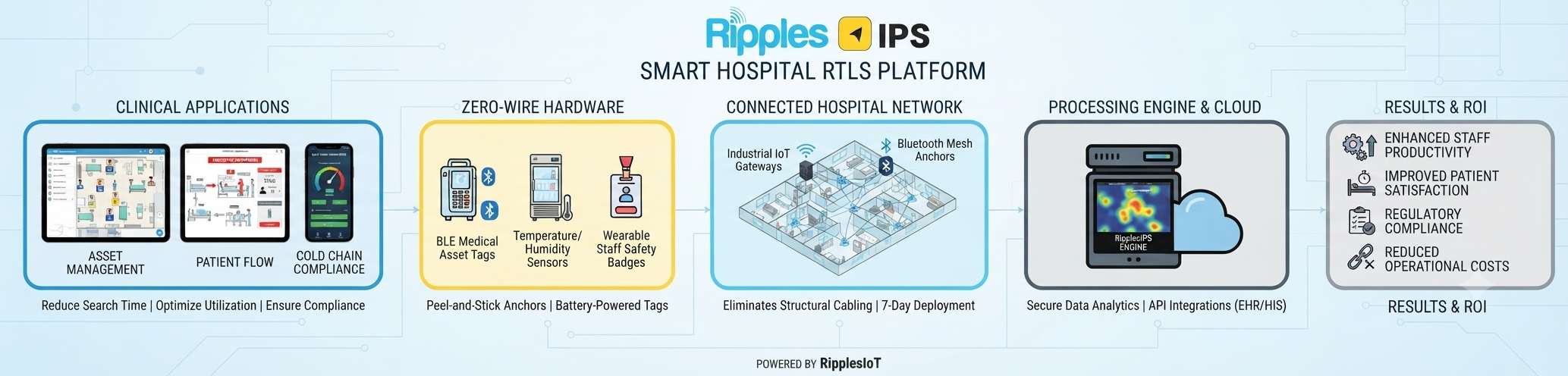
Modern healthcare facilities face a constant operational challenge: locating, maintaining, and auditing hundreds or thousands of portable biomedical assets across sprawling multi-storey campuses. Traditional manual inventory checks and static spreadsheets are no longer sufficient to manage high-value equipment like infusion pumps, portable ventilators, and cardiac monitors.
Deploying a robust hospital RTLS tracking system transforms biomedical engineering, logistics, and clinical workflows by providing continuous, real-time visibility.
Understanding Hospital RTLS Architecture & Advanced Protocols
A high-performance real-time location system (RTLS) relies on a synchronized ecosystem of hardware and software components designed to operate seamlessly within complex healthcare environments:
Active Tags & Beacons: Compact Bluetooth Low Energy (BLE) transmitters attached to mobile medical devices, wheelchairs, and surgical trays.
BLE Mesh & Gateway Infrastructure: Strategic gateway placements and BLE Mesh topologies enable resilient, multi-hop device communication across extensive hospital wings, ensuring zero dead zones even in dense clinical environments.
Angle of Arrival (AoA) Precision: Moving beyond basic RSSI proximity, cutting-edge deployments leverage Angle of Arrival (AoA) technology to deliver sub-metre, room-level positioning coordinates, eliminating cross-room ambiguity in emergency wards.
Pick-to-Light Integration: For medical store rooms and sterile supply departments, pick-to-light systems integrate directly with RTLS databases, illuminating LED tags on shelves or equipment bins to guide staff instantly to the correct surgical kits or consumable stock.
Core Applications of RTLS in Healthcare
1. Automated Biomedical Equipment Audits
Regulatory compliance and regular equipment audits are mandatory for maintaining hospital accreditation. Automated RTLS infrastructure replaces time-consuming manual floor sweeps with instant zone scanning, verifying asset presence and generating tamper-evident digital logs for audits. For a detailed breakdown of workflow-level applications, explore Software Associates’ guide on best RTLS use cases for hospitals.
2. Eliminating Search Delays for Clinical Staff
Nursing and biomedical engineering teams frequently lose valuable minutes hunting for critical equipment across departments. Room-level tracking eliminates search friction, allowing staff to instantly locate available infusion pumps or stretchers through integrated software dashboards. For software-level patient monitoring and tracking features, see the RTLS patient tracking software guide.
3. Optimising Utilisation and Capital Expenditure
Beyond simple location tracking, advanced RTLS platforms monitor active runtime hours and idle durations. This data helps hospital administrators prevent unnecessary capital expenditure on redundant machinery by identifying underutilised assets across wards.
Choosing the Right Hardware Protocol
When designing an enterprise sensor deployment, selecting the appropriate wireless protocol dictates system accuracy,battery longevity, and scalability:
Bluetooth Low Energy (BLE): Offers an optimal balance of low power consumption, cost-effective beacon hardware, and reliable room-level accuracy.
Comparison of Technologies: For a deeper technical analysis of how BLE compares to ultra-wideband (UWB) and RFID alternatives in healthcare settings, read our comparison of RTLS technologies.
Enterprise Integration and Scalability
Standalone tracking tools create isolated data silos. To maximise operational efficiency, real-time location events must feed directly into core enterprise management systems. Synchronising asset tracking data with hospital ERP and maintenance platforms ensures that depreciation, preventive maintenance work orders, and department-level allocations remain permanently aligned.
To explore enterprise-grade sensor deployments and tag specifications, visit our dedicated overview on asset tracking in hospitals.
Ready to Transform Your Hospital Asset Tracking?
Streamline biomedical audits, eliminate equipment search delays, and integrate high-precision BLE mesh architecture into your healthcare facility. Get in touch with the RipplesIOT team today to schedule a custom enterprise RTLS demonstration.
Frequently Asked Questions – Hospital RTLS
What makes BLE mesh and AoA superior for hospital environments?
BLE mesh ensures robust, fault-tolerant signal coverage across multi-storey campuses, while Angle of Arrival (AoA) technology provides pinpoint sub-metre room accuracy required for critical care assets.
How does RTLS integrate with existing hospital software?
Modern RTLS platforms use robust API integrations to pass location telemetry and status updates directly into enterprise hospital management systems and CMMS software.
Can Hospital RTLS assist with preventive maintenance schedules?
Yes. By tracking actual equipment usage hours rather than relying solely on calendar intervals, biomedical teams can trigger maintenance work orders based on actual equipment wear and tear.
Read our Real-time asset tracking FAQ