
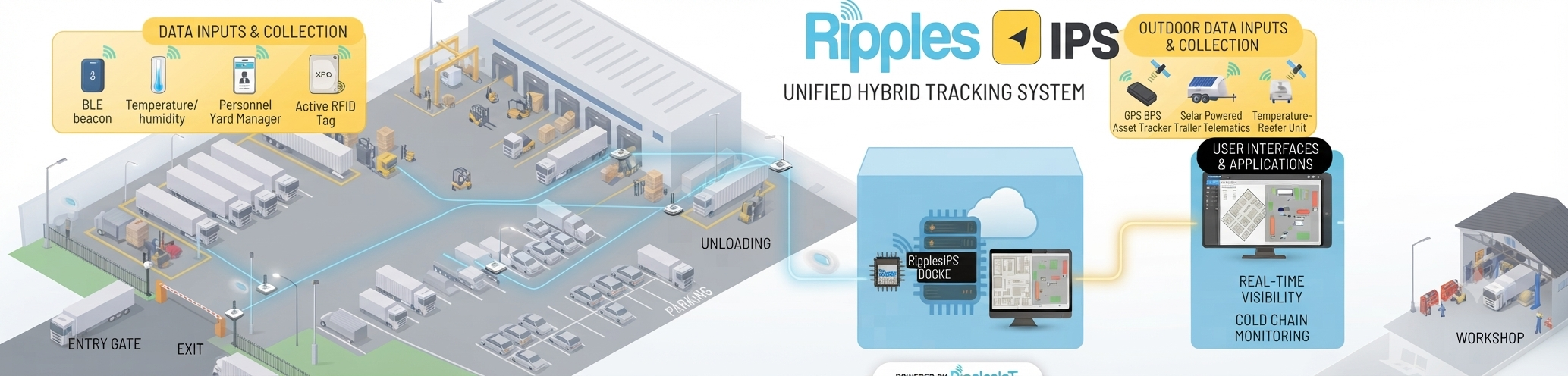
Affordable Yard Management & Trailer Tracking for Mid-Market Logistics
Optimising operations with logistics yard management systems. Modern supply chain efficiency often hinges on the “middle mile”—the critical transition between warehouse operations and long-haul transport. However, without digital oversight, the yard can become a site of congestion and high operational costs. Adopting a specialised RTLS yard management system allows businesses to convert these blind spots into transparent, data-driven environments that integrate seamlessly with your warehouse inventory tracking.
⚡ Need to validate dwell times and layout coverage quickly? Evaluate our 30-Day RTLS Starter Kit.
Industry-Specific Logistics Yard Management Solutions
Food & Beverage Cold Chain Compliance & Distribution Tracking
Cold zone tracking is critical for food operators. Our logistics yard management RTLS system supports separate geofenced zones for ambient, chilled, and frozen areas—with automatic alerts when a temperature-sensitive trailer dwells outside its designated zone beyond a set threshold. BRC audit logs are generated automatically from gate-in to dock assignment to gate-out, exportable as PDF or CSV.
GDP-Compliant Pharmaceutical Logistics & Cold Chain Tracking
GDP-compliant yard management requires a complete, timestamped chain of custody from initial gate arrival to the unloading bay. Our RTLS platform automatically logs every movement—including carrier details, arrival timestamps, dock assignments, dwell times, and integrated cold-chain monitoring temperature excursions—followed by secure gate-out confirmation. This eliminates manual data entry errors and ensures an unbroken, audit-ready compliance trail.
Regional 3PL Operations: Carrier Performance & Haulier SLA Management
Carrier performance reporting becomes objective when dwell time, TAT, and dock utilisation are tracked automatically. Our trailer tracking system for logistics gives regional 3PLs the data to manage haulier SLAs, evidence performance to clients, and identify yard bottlenecks before they affect throughput.
💡 Micro-Conversion Prompt: Running a multi-carrier 3PL or cold chain hub? Talk to an RTLS Specialist to tailor your zone rules.
Key RTLS Capabilities for Automated Yard Operations
Real-time trailer tracking — live position of every trailer and vehicle across all yard zones, updated continuously without manual input.
Automated gate check-in — beacon detection at gate anchors replaces manual gatehouse logging, cutting check-in time by 60–80%.
Dock scheduling RTLS — dock assignment triggered by actual gate arrival, integrated with your WMS or TMS via REST API.
Dwell time monitoring — automatic alerts when trailers exceed allocated staging windows, directly reducing demurrage exposure.
Bluetooth yard tracking — sub-metre accuracy across full yard areas using Bluetooth AoA, with no Wi-Fi dependency.
Geofencing and zone alerts — restricted area monitoring, cold zone compliance, and high-traffic pedestrian safety zones.
Audit-ready reporting — TAT by carrier and dock, temperature logs, movement history—all exportable for BRC, GDP, and customer SLA reviews.
The Power of 0-Wire Yard Automation
The most significant hurdle to digitalising a logistics yard has traditionally been the cost and complexity of infrastructure. Modern solutions now utilise wireless yard management solutions, eliminating the need for expensive cabling or electrical work during your facility layout optimisation. This plug-and-play approach uses battery-powered anchors and tags to create a seamless tracking network.
Key Functionalities of This Infrastructure:
Sub-meter Precision: By leveraging Bluetooth AoA (Angle of Arrival) technology, managers can achieve high precision for locating trailers, containers, and inventory pallets.
Live Asset Localisation: A Bluetooth Mesh RTLS network provides real-time coordinates across the entire yard, removing the need for manual yard checks or search time.
Automated Gate Control: Digitalising check-in and check-out processes accelerates driver turnaround and ensures data accuracy without manual entry.
Hybrid Tracking: For operations that move between indoor and outdoor spaces, a hybrid approach combining BLE and GPS ensures a no-gap view of the entire fleet.
Tangible Business Benefits for Growing Fleets
Transitioning from manual logs to automated logic offers immediate ROI through several strategic advantages:
Eliminating Demurrage: Automated dwell-time alerts ensure trailers are moved before expensive detention and demurrage penalties from carriers kick in.
Optimised Throughput: Real-time visibility into dock occupancy via interactive IoT dashboards ensures that every loading bay is utilised to its full potential, increasing the number of vehicles processed daily.
Enhanced Safety: Reducing foot traffic in high-density areas where heavy machinery operates significantly lowers the risk of workplace accidents, aligning with our worker safety and yard tracking standards.
Operational Intelligence: Comparisons of time spent in various zones allow managers to identify bottlenecks and optimise the movement paths of yard spotters.
Use Case Scenarios
Manufacturing and JIT Logistics: In “Just-in-Time” manufacturing, a thirty-minute delay can stall a production line. An automated yard system ensures that trailers containing critical components are prioritised for unloading the moment they arrive at the gate.
3PL and Distribution Hubs: For high-volume distribution centres, managing hundreds of daily movements is a constant challenge. Yard automation allows these facilities to handle higher throughput using existing infrastructure, maximising every square foot of parking space.
Fleet Workshop Management: Beyond the yard, RTLS for fleet workshop management and repair phase tracking automates digital job cards the moment a vehicle enters a maintenance zone, tracking exactly how long it spends in each repair phase to improve shop floor productivity.
Frequently Asked Questions (FAQ)
1. How does 0-wire infrastructure reduce deployment costs in a logistics yard?
Traditional tracking systems often require extensive cabling and trenching for power and data. By utilising 0-wire RTLS deployment, the system uses battery-powered anchors and sensors, eliminating expensive electrical work and allowing rapid installation without disrupting ongoing yard operations.
2. Achieving 10cm Precision with Bluetooth AoA Trailer Tracking
Bluetooth AoA (Angle of Arrival) provides sub-meter accuracy, often reaching precision levels of 10 to 30 centimetres. This ensures managers can identify not just which zone a trailer is in, but the exact bay or parking slot it occupies.
3. Can the system track assets as they move between the yard and the warehouse?
Yes. A Bluetooth Mesh RTLS creates a unified network that covers both indoor and outdoor environments, ensuring that as an asset moves from the gate to the yard and into the warehouse, its status and location are updated in real-time.
4. How does the system help in Eliminating Carrier Demurrage Charges?
The software automatically logs the entry time for every trailer at the gate. By setting up automated alerts based on dwell-time logic, the system notifies supervisors before a trailer exceeds its free-time limit, reducing logistics costs.
5. Is the solution scalable for large-scale distribution hubs?
Absolutely. The Industrial Bluetooth IoT framework handles thousands of tags simultaneously, scaling simply by adding more battery-powered anchors to cover expanded areas.
6. Can yard management data be integrated with maintenance schedules?
Yes. By integrating yard data with fleet workshop management, companies can automate digital job cards when a vehicle moves into a maintenance zone.
Ready to evaluate RTLS in your yard?
Our Logistics Yard Management RTLS Starter Kit deploys in under 30 days with zero cabling, covering up to 20,000 square metres with waterproof tracking tags. Validate trailer dwell times and asset visibility before committing to full deployment.
[ Request Starter Kit / Get a Custom Quote ]
Ripples IoT Pte Ltd
Ripples IoT – 0-wire RTLS solutions for warehouses and yard management
Ripples IoT Pte Ltd builds 0-wire BLE RTLS solutions for asset tracking, inventory monitoring, and cold chain visibility across warehouses, yards, factories, and hospitals. Part of the SA group of companies, delivering industrial software since 1991.