
RTLS Warehouse Pallet Tracking & Theft Prevention Systems
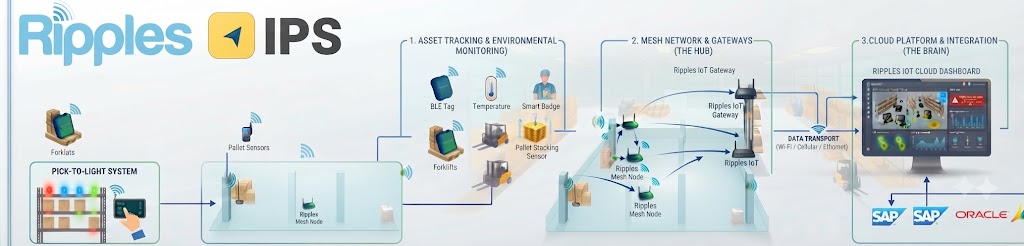
An RTLS warehouse pallet tracking system replaces manual stocktakes and radio calls with continuous, real-time visibility over every pallet on your shop floor. In today’s fast-paced logistics world, efficiency is king — traditional tracking methods routinely fall short, leading to misplaced inventory, wasted search time, and frustrated teams. As an IoT pallet management system, RTLS attaches wireless BLE tags to pallets, delivering automatic identification, live location data, and active theft deterrence without a single manual scan. Deploying robust Bluetooth inventory tracking beacons directly onto pallets or handling units ensures continuous telemetry from receiving bays to high-rack storage.
A typical setup includes active IoT tags attached to pallets or forklifts and anchors installed on walls or ceilings. Before cargo reaches this stage, yard management RTLS tracks trailers and containers from gate check-in through to dock assignment
Know the Moment Stock Moves: Active Theft Deterrence
Warehouse shrinkage rarely announces itself. An RTLS warehouse pallet tracking system from RipplesIPS triggers instant alerts the moment stock moves outside designated geofenced zones or is accessed outside authorised hours. This creates a timestamped audit trail for every movement with zero floor cabling required.
The same active BLE tags running your picking workflows double as a primary theft-prevention layer, aligning with movement-monitoring frameworks established by the Transported Asset Protection Association (TAPA). Continuous location monitoring removes coverage blind spots across high-density storage bays.
Core Pallet-Level Features
Beyond baseline coordinates, warehouse operations leverage targeted operational modules daily:
- Find a Pallet: Instant lookup by SKU or Tag ID returning real-time sub-metre coordinates and historic entry/exit logs.
- Forklift Last-Known-Location: Bluetooth tracking devices mounted to forklifts report real-time status and operational availability, reducing equipment search times during peak fulfilment.
- Pallet Grouping for BOM Accuracy: Groups production pallets linked to specific Bill of Materials (BOM) to ensure full batch shipping and eliminate split-shipment errors.
- Cable-Free Deployment for Legacy Sites: Operates entirely on battery-powered anchors, enabling rapid installation in older facilities without trenching or conduit installation.
Hardware Architecture: Traditional Wired RFID vs. BLE Mesh
Evaluating real-time RTLS warehouse pallet tracking architecture requires reviewing both capital costs and site disruption during deployment:
| Cost & Operational Component | Traditional Wired RFID | RipplesIPS (0-Wire BLE Mesh) |
|---|---|---|
| Trenching & Cabling | $15–$40 per linear metre | $0 (100% Wireless) |
| Reader / Anchor Cost | $2,000–$8,000 per portal | ~$150–$300 per anchor |
| Installation Labour | Specialised RFID engineers (weeks) | In-house IT / Maintenance (days) |
| Facility Downtime | High (drilling, power cuts) | Zero (Peel-and-stick) |
| System Scalability | High friction (requires new cabling) | Instant (add wireless anchors) |
Warehouse Theft Prevention by Region
Geographic risk profiles vary significantly. The RipplesIPS framework adapts to localised operational and regulatory requirements:
- United Kingdom (After-Hours Risk): Monitors facility access continuously, flagging off-hours stock movement and linking location updates with our lone worker safety solution.
- Germany (Insurance Compliance): Generates verifiable, timestamped movement trails required by German industrial insurers and logistics compliance standards.
- South Africa (High-Value FMCG/Pharma): Enables value-based zone restrictions, pushing high-priority alerts if restricted pharmaceutical inventory crosses perimeter boundaries.
- Brazil (NF-e Tax Reconciliation): Matches physical stock locations against Nota Fiscal Eletrônica (NF-e) records to resolve physical discrepancies before tax liabilities occur, integrating directly with our cold chain monitoring module.
Pinpoint Rack & Bay Location Accuracy
In vertical racking environments, traditional barcode scanning frequently breaks down due to operator oversight or damaged labels. Implementing 0-Wire BLE RTLS provides high-precision spatial awareness down to specific shelf, bay, and aisle slots.
Using indoor positioning technology such as Bluetooth Angle of Arrival (AoA) directional arrays, forklift drivers are guided via screen-mounted maps directly to the exact pallet position. This eliminates search times, minimises put-away errors, and enforces strict First-In, First-Out (FIFO) inventory rotation.
Automated Inventory Audits & Cycle Counting
Manual cycle counts disrupt daily warehouse operations and consume valuable labour hours. Active RTLS tags mounted on reusable plastic pallets, wire cages, or stillages broadcast presence updates continuously.
- Zero-Touch Auditing: The system conducts real-time automated stock checks without stopping forklift traffic.
- Misplacement Alerts: Automated triggers flag items stored in incorrect temperature or hazard zones instantly.
- Dwell Time Analytics: Identify slow-moving pallets and bottlenecked staging bays to increase warehouse space utilisation.
WIP & High-Value Asset Management
Tracking custom tooling, returnable transport packaging (RTP), and staged work-in-progress (WIP asset management) sub-assemblies is critical for seamless manufacturing-to-warehouse handoffs. RipplesIPS pairs industrial tags with manufacturing RTLS workflows to track asset transitions through staging areas, wash bays, and shipping docks.
📖 Global Logistics Standard: Refer to the GS1 EPCIS Standard for Track and Trace to understand how serial location data standardises supply chain exchange formats across global warehouse management platforms.
Logistics Yard Operations & European Distribution Hubs
Warehouse visibility must not stop at the loading dock door. Outdoor logistics yards demand ruggedised, IP67-rated tracking devices to oversee trailers, dollies, and staging pallets exposed to extreme weather conditions.
For high-density European gateways in the Netherlands and Belgium (Benelux) serving Port of Rotterdam and Antwerp-Bruges logistics corridors, RipplesIPS provides plug-and-play deployments. These configurations maintain continuous stock visibility across cross-docking operations and international freight transport corridors.
Seamless WMS & ERP Integration Architecture
RipplesIPS functions as an enterprise location middleware layer. Utilising REST APIs and MQTT brokers, spatial coordinates and geofence events feed directly into enterprise systems such as SAP EWM, Microsoft Dynamics 365, and Manhattan WMS.
Automated alerts update job card statuses, log dwell times, and verify outbound shipment accuracy, ensuring your digital twin reflects physical inventory movements accurately.
Frequently Asked Questions (FAQ)
What is the accuracy of RTLS for warehouse pallet tracking?
Accuracy depends on the underlying technology. Standard Wi-Fi provides 5–10 metre precision, while an indoor positioning system using Angle of Arrival (AoA) can achieve centimetre-level accuracy. For most pallet tracking use cases, BLE 5.0 offers a balanced 1–3 metre accuracy — sufficient to identify specific rack locations.
How does RTLS compare to traditional barcode scanning?
Traditional barcodes require manual labour and line-of-sight scanning, which is prone to human error. Automated pallet tracking software removes manual scans by updating the location automatically as the pallet moves.
What are the main benefits of pallet tracking for ROI?
The primary benefits of a pallet tracking system include improved inventory accuracy, reduced search times for lost pallets, and improved forklift safety through zone monitoring.
Can this system integrate with my existing WMS?
Yes. Modern RTLS solutions bridge physical movement and digital records. By integrating with your existing warehouse tracking system, the RTLS acts as the “source of truth” for real-time asset coordinates, feeding data directly into your WMS or ERP.
What hardware is required for a pallet tracking deployment?
A typical setup includes active IoT tags attached to pallets or forklifts and anchors (gateways) installed on walls or ceilings. These anchors form a network that calculates each tag’s position in real time.
How does a pallet tracking system detect warehouse theft?
The system supports theft prevention via two mechanisms: zone-breach alerts trigger instantly when a tagged pallet moves outside its designated storage/dispatch zone, and after-hours access alerts flag movement outside authorised time windows. Correlated with worker tags, every alert generates a timestamped audit trail.
Does RTLS include pallet weight monitoring for theft detection?
No. RipplesIPS is a location-based RTLS pallet tracking system without load-cell or weight-discrepancy hardware. Instead, zone-dwell analysis flags when a pallet remains stationary in an unusual location longer than expected, indicating potential partial offloading based on location and time data.
What alerts does the system generate for unauthorised pallet movement?
The dashboard generates zone-breach alerts (crossing virtual boundaries without a WMS dispatch event), tag-removal alerts (detachment or lost signal), after-hours movement alerts, and forklift-pallet correlation alerts (entering high-value zones without a pick task).
Does the system create an audit trail for insurance claims?
Yes. Every pallet movement is logged with a timestamp, zone identifier, and tag ID—plus correlated worker tag IDs when active. This data is stored in the cloud and exportable for insurance submissions and audits.
How does RTLS pallet theft prevention differ from CCTV?
CCTV passively records visual footage requiring manual review after an event. RTLS alerts in real time during unauthorised movement, identifies specific SKU/pallet IDs, tracks assets through obscured racking, and provides timestamped data to cross-reference with CCTV.
Ready to Eliminate Warehouse Search Time & Shrinkage?
Deploy 0-Wire BLE RTLS warehouse pallet tracking across your warehouse bays and logistics yards in under 7 days with zero production downtime.