
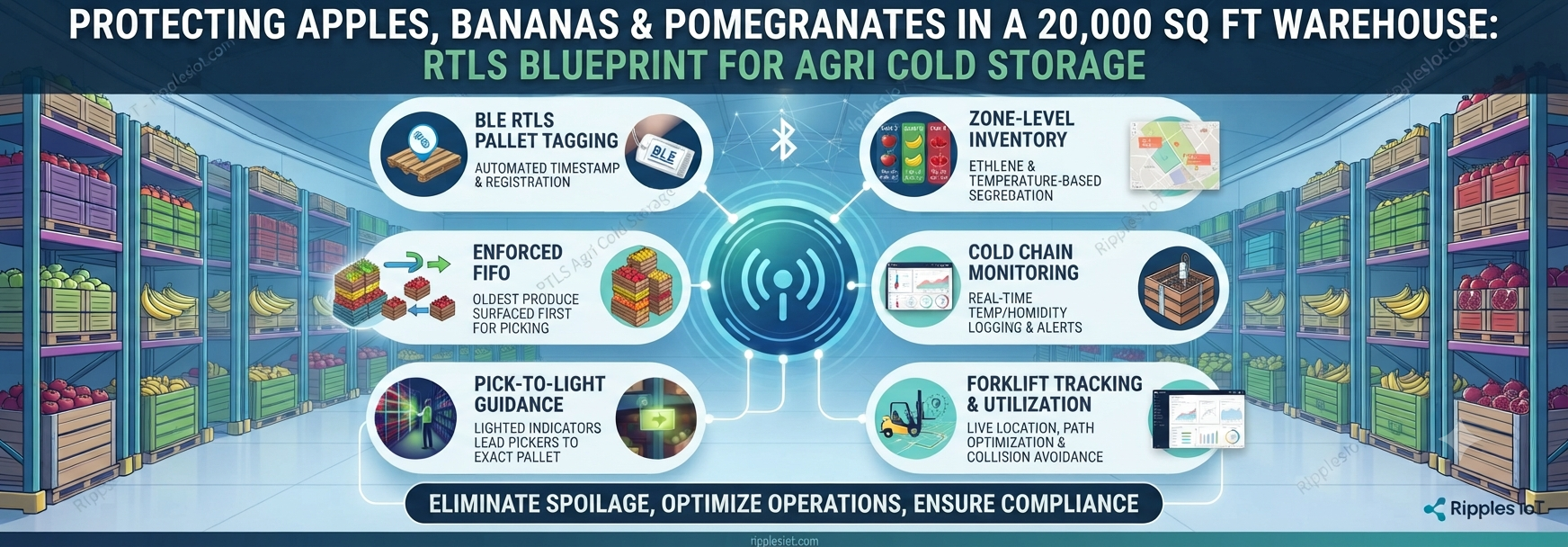
Protecting Apples, Bananas and Pomegranates in Warehouse: Agri Cold Storage RTLS
Agri cold chain warehouse management – Fresh produce warehouses live on borrowed time. Apples, bananas and pomegranates each ripen and spoil on different clocks, and a single misrouted pallet or a two-hour temperature excursion can wipe out a full truckload of margin. For a 20,000 square foot facility running 3,000 pallets and 20 forklifts, spoilage isn’t a shelf-life problem anymore; it is a visibility problem. Here is how a BLE RTLS warehouse pallet tracking system closes that visibility gap without new cabling or downtime.
FIFO That Actually Enforces Itself
Manual FIFO relies on staff reading pallet labels and doing the right thing every single time, across every shift. At agri-sector volumes, that assumption breaks down fast. A FIFO-first warehouse monitoring system tags every pallet with a Bluetooth beacon at receiving, timestamps it, and tracks its age continuously across storage zones.
For critical perishable assets, relying on standard single tags can occasionally introduce blind spots if a tag is damaged or shielded by dense cargo. Upgrading to a dual tag redundancy configuration ensures zero signal dropouts and continuous tracking even under heavy frost or multi-layered stretch wrapping. The oldest apples, bananas or pomegranates are always surfaced first for picking, automatically, with no dependence on staff memory or handwriting. For fruit categories with genuinely different shelf lives sitting under one roof, this kind of automated FIFO implementation is what prevents a slow-moving pomegranate pallet from quietly ageing out behind faster-moving stock.
Pick to Light for Faster, Error-Free Picking
Search time is dead time, and dead time is spoilage time for perishables sitting in a staging area. Modern warehouses are increasingly pairing spatial tracking with visual cues to eliminate picking errors entirely.
By integrating pick-to-light capabilities with your real-time locating infrastructure, smart indicators mounted at rack and bin level illuminate exactly where the next FIFO-sequenced pallet sits. This guides pickers directly to the correct spot instead of having them walk rows looking for a SKU or second-guessing inventory sheets. Across 3,000 pallets spread over 20,000 square feet, that difference compounds into meaningfully shorter dock-to-truck cycles and fewer misrouted cartons of fruit.
Zone-Level Inventory Management by Fruit Category
Apples, bananas and pomegranates don’t just need different temperatures; they often need separate zones to avoid ethylene cross-contamination accelerating ripening in neighbouring produce. Sub-meter Bluetooth Angle of Arrival positioning maps every pallet to its exact zone, rack and bin in real time, even through the interference and line-of-sight challenges that stacked pallets typically create for conventional tracking. If a pallet drifts outside its designated banana or pomegranate zone, the system raises an alert immediately, rather than surfacing the error days later during a manual audit.
Cold Chain Management, End to End
Bananas ripen fast above their ideal range, apples lose crispness in fluctuating humidity, and pomegranates are sensitive to both chilling injury and moisture loss. A dedicated cold chain monitoring dashboard logs temperature and humidity continuously from BLE sensors placed across cold rooms and staging zones, with instant SMS and email alerts the moment a reading crosses a configured threshold. This isn’t a spot-check replacement; it’s a documented, HACCP-aligned traceability record for every pallet, useful both for internal quality control and for buyer or export compliance audits.
Forklift Tracking Across a 20-Unit Fleet
Twenty forklifts working a 20,000 square foot floor create real collision and utilisation risk, particularly around narrow cold-storage aisles. BLE-tagged forklift tracking shows live location, in-use status and travel patterns for the whole fleet on one dashboard, helping supervisors spot bottlenecked aisles, idle equipment, and near-miss patterns before they become incidents. Combined with pallet-level RTLS data, it also closes the loop on which forklift moved which pallet and when, useful when a temperature excursion or a misplaced pallet needs to be traced back to a specific handling event.
Deploying Without Disrupting Operations for Agri cold storage
Because the entire system runs on a battery-powered 0-wire BLE mesh, there’s no new cabling, no electrical certification delay and no facility downtime during rollout. For a facility this size, deployment typically completes in about a week, with beacons on pallets, anchors overhead, and forklift tags installed while the warehouse keeps operating normally.
For agri-sector operators weighing where to start, our warehouse monitoring systems hub and RTLS FAQ are good next stops, alongside case studies on the IoT and RTLS blog archive.