
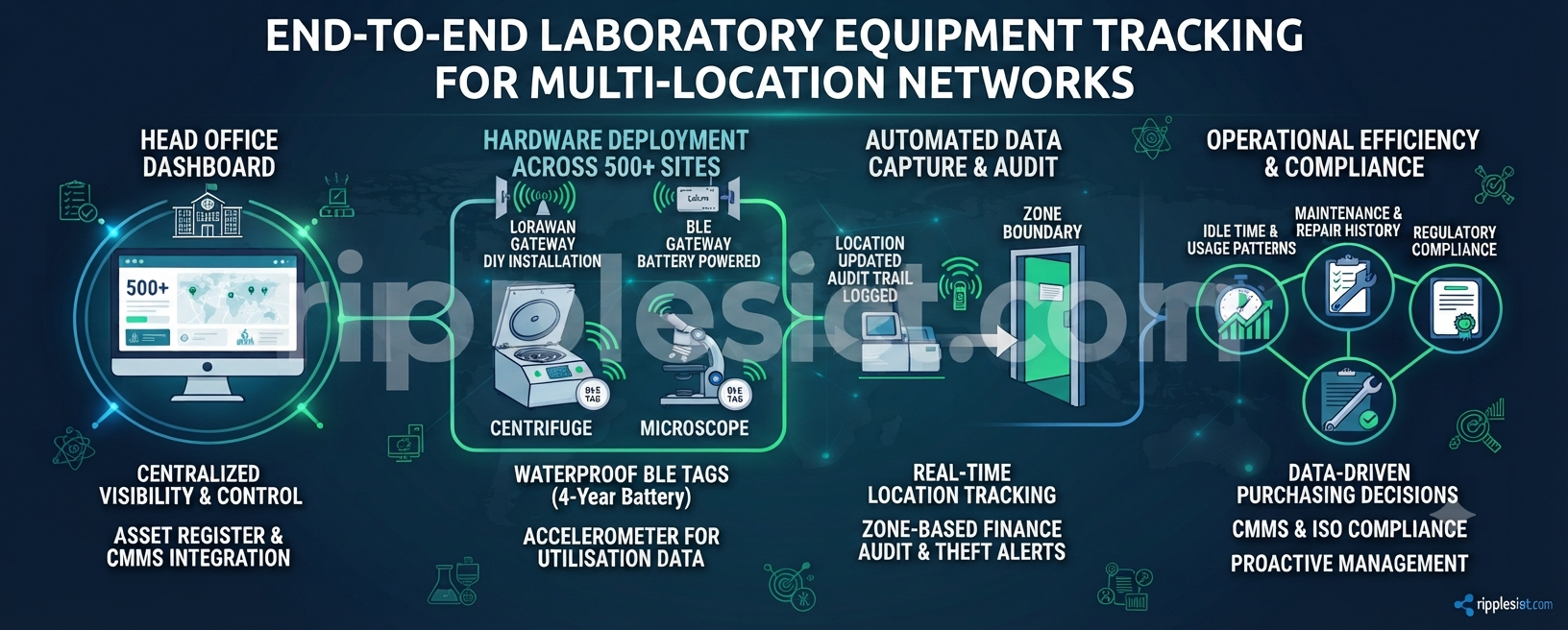
Laboratory equipment tracking – Running a diagnostic or research laboratory is hard enough on one site. Running 500 laboratories across the country from a single head office, with equipment that moves between rooms, technicians, and sometimes out of the building entirely, is a different problem altogether. Real-time laboratory equipment tracking gives head office the same visibility into every lab that a site manager has standing on the floor, without needing to be there.
RipplesIPS combines battery-powered BLE RTLS hardware with CMMS software integration to solve this in one system, rather than bolting together a location tracker and an asset register that never talk to each other. As RTLS for laboratories, it’s built around the specific mix of finance-audit, theft, and utilisation questions a lab network faces, and it gives head office multi-location laboratory monitoring from one dashboard rather than 500 separate logins.
Real-Time Laboratory Equipment Tracking Across 500 Locations
At this scale, spreadsheets and manual audits fall apart. A centrifuge logged as “present” during last quarter’s physical count could have been moved between labs, sent for repair, or left in a storage room three floors away. Multiply that uncertainty by 500 sites and the finance and compliance teams lose the audit trail that regulators and auditors expect.
A lab asset tracking software layer built on RTLS closes that gap by giving every piece of tagged equipment a live, timestamped location that updates automatically as it moves, no manual scanning required.
How the Hardware Works
The deployment is designed for facilities teams to install without specialist contractors:
LoRaWAN gateways provide long-range backhaul across large lab campuses and multi-building sites, reducing the number of access points needed compared with Wi-Fi-only coverage.
Battery-powered BLE gateways handle room-level and zone-level positioning inside labs, cold rooms, and storage areas, with no mains wiring required, so they can be repositioned as lab layouts change.
Waterproof BLE tags with a 4-year battery life attach directly to equipment, from centrifuges and analysers to trolleys and mobile carts, and survive the washdown and spill conditions typical of lab environments.
Because the gateways are battery-powered rather than mains-wired, a new lab site can be brought onto the network in days rather than weeks, which matters when the deployment target is 500 locations.
Theft Detection and Zone-Based Finance Audit
Every tagged item is assigned to defined entry and exit zones within each lab. When equipment crosses a zone boundary it isn’t authorised to leave, such as a lab door or building perimeter, the system logs the event and can trigger an alert. This gives finance and compliance teams a real lab theft detection system rather than a reactive one built on end-of-quarter stocktakes.
The same zone log doubles as a presence audit trail for finance. Instead of asking site staff to confirm asset locations manually, head office can pull a location history for any tagged item, at any of the 500 sites, from the central dashboard.
Laboratory Equipment Utilisation Tracking with Accelerometer Data
BLE tags fitted with accelerometers report movement and vibration patterns from the equipment they’re attached to. This gives a baseline read on whether a piece of equipment is active, idle, or unused over a given period, useful for identifying underused instruments across a multi-site network before a purchasing decision is made for new equipment.
It’s worth being precise about what this baseline shows. Accelerometer-based movement gives idle-time and usage-pattern data from the equipment’s physical activity. It does not read machine-level operating state such as cycle counts, error codes, or process parameters—that level of detail requires direct PLC or instrument integration where the equipment supports it. For most lab equipment tracking and utilisation-planning purposes, movement-based data is enough to flag which assets across the network are earning their footprint and which aren’t.
CMMS Integration: Inventory, Repairs, and Spares
Location and utilisation data is only half the picture. Paired with CMMS software, the same central dashboard also carries equipment inventory, repair history, breakdown logs, and spares availability for every asset, giving head office one view instead of switching between a location system and a maintenance system.
The CMMS layer itself, covering work orders, spares management, and breakdown-to-repair workflows in depth, is a distinct discipline from RTLS. For teams evaluating that side of the platform, Software Associates CMMS covers inventory, repair, and maintenance-history functionality in detail.
Built for Distributed, Low-Bandwidth Sites
A 500-site rollout has to assume uneven infrastructure. The dashboard is built to work over low-bandwidth connections, so a lab in a smaller town isn’t left blind because its internet connection can’t support a heavier platform. Hardware is designed for local, DIY-friendly installation, and spares (tags, gateways) are stocked for straightforward replacement without a specialist call-out. That combination of affordability, low-bandwidth tolerance, and DIY deployment is what makes a real-time tracking rollout practical at 500 locations rather than just at a flagship site.
Data retention, uptime, and general system integrity practices for a deployment of this size should follow recognised laboratory quality frameworks such as ISO/IEC 17025 for testing and calibration laboratories.
Where This Fits in the RipplesIoT Product Range
This laboratory use case sits alongside RipplesIoT’s other RTLS applications. If you’re evaluating the underlying positioning technology, see RipplesIPS: RTLS Real-Time Location System. For warehouse-style inventory tracking, see Inventory Tracking Beacons. And for hospital environments specifically, see RTLS for Hospitals.
Frequently Asked Questions
How does the system handle labs with poor internet connectivity or low-bandwidth sites?
The dashboard and data architecture are engineered to operate efficiently over low-bandwidth connections. Even if a regional or smaller-town lab has limited internet connectivity, critical tracking data continues to sync without lag, ensuring head office never loses visibility.
Can site staff easily install the hardware without technical contractors?
Yes. The deployment is designed for a DIY-friendly rollout by internal facilities teams. The battery-powered BLE gateways require no mains wiring, and waterproof BLE tags attach directly to equipment, allowing new lab sites to be onboarded in days rather than weeks.
What is the battery life of the equipment tags and gateways?
The waterproof BLE tags come with a long-lasting battery life of up to 4 years. Because both gateways and tags are battery-powered, they offer total flexibility and can be easily repositioned whenever lab layouts or room configurations change.
How does accelerometer data help with equipment utilisation tracking?
BLE tags are equipped with accelerometers that measure movement and vibration patterns. This gives head office an accurate baseline to see whether expensive instruments (like centrifuges and analysers) are actively running, sitting idle, or underused across the network.
Does the accelerometer data show deep machine-level operating states?
No. Accelerometer-based data tracks physical movement, vibration, and idle times. It does not read internal machine errors, cycle counts, or deep process parameters, which require direct PLC or instrument integration where supported.
How does the system help with theft prevention and audits?
Each tagged item is mapped to predefined entry and exit zones (such as lab doors or building perimeters). If a piece of equipment crosses an unauthorised boundary, the system logs the event and triggers an alert, simultaneously providing an automated presence audit trail.
Does the platform combine location tracking with maintenance records?
Yes. By integrating with a CMMS, the central dashboard merges real-time location and utilisation data with equipment inventory, repair history, breakdown logs, and spares availability for complete asset management control.
Running equipment across multiple labs and want a single dashboard for location, utilisation, and theft alerts? Talk to RipplesIoT about a multi-site RTLS rollout.