

Department-by-department hospital RTLS planning guide
Hospital RTLS planning guide – Most hospitals evaluating RTLS for the first time make the same mistake: they try to solve everything at once. One department’s urgency becomes the entire brief, the scope expands to cover every floor, and the project stalls before a single beacon is mounted.
The better approach is to treat each department as its own use case — with its own problem, its own data requirement, and its own definition of success. Once one department is live and producing results, the next becomes easier to justify and faster to deploy.
This guide walks through each department in order of priority, based on where operational pain is highest and where RTLS delivers measurable outcomes fastest. The principles apply across hospital systems in India, Brazil, and across East and Southern Africa — though the compliance frameworks and accreditation bodies differ by region, as noted throughout.
Where most hospital RTLS rollouts go wrong
The instinct is to start with the most technically complex use case — OT asset tracking, cold chain compliance, full patient journey mapping. These are real needs, but they require buy-in from multiple departments, involve sensitive zones, and take longer to show results.
The faster path to organisation-wide adoption is to start where the pain is most visible to patients and easiest to measure: the outpatient queue. A patient waiting 90 minutes in OPD is a problem every hospital administrator can see, and every board can quantify. RTLS that reduces the wait time from 90 minutes to 40 minutes produces a number that funds the next deployment.
1. Start with OPD: patient flow and wait time reduction
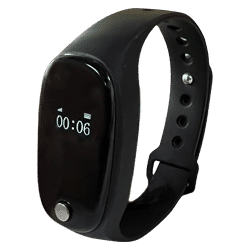
The registration desk is where RTLS value is most immediately visible. Attaching a lightweight Bluetooth wearable tag to each patient at registration gives the front-desk team a live view of every patient’s location — which counter they are at, how long they have been waiting, and which department is creating a bottleneck.
The key metric to track from day one is dwell time per touchpoint: how long does a patient spend at registration, at the doctor’s room, at diagnostics, at pharmacy? Once you have that baseline, any intervention — additional staff at peak hours, queue rebalancing, alert thresholds — becomes measurable against it.
In India, patient wait time data feeds directly into NABH Quality Indicator reporting. In Kenya, Zimbabwe, Tanzania, and Zambia, Ministry of Health facility assessment frameworks increasingly include patient experience and waiting time metrics as part of hospital licensing and quality reviews. In Brazil, the ANS (Agência Nacional de Saúde Suplementar) and accreditation bodies such as ONA (Organização Nacional de Acreditação) include patient flow and wait time standards in their assessment criteria — making the same RTLS data relevant to accreditation submissions.
For hospitals with multiple centres, the same platform aggregates data across all locations without requiring separate installations at each site.
Read more: Reducing and measuring patient wait times with RTLS
2. Pharmacy: the department where RTLS pays back the fastest
Pharmacy is the highest-frequency touchpoint in any hospital and the one where manual processes create the most visible patient frustration. The core problem is not dispensing speed — it is retrieval. When a patient arrives at the counter, staff spend minutes manually scanning bags in alphabetised hanging zones, often missing refrigerated items entirely.
A Pick-to-Light system eliminates the search entirely. When a patient’s name is entered at the counter, the tag on their bag flashes a high-visibility LED at the exact shelf or fridge location. Retrieval time drops by up to 80%. Urgent orders, complex multi-fills, and family-grouped prescriptions are managed through a single prioritised visual queue rather than tribal knowledge.
The same RTLS infrastructure that guides dispensing also monitors cold storage temperature continuously. In India, NABH standards require documented cold chain compliance for pharmaceutical storage. In Brazil, ANVISA RDC 430/2020 sets specific temperature range and logging requirements for pharmacy cold storage — continuous automated logging with tamper-evident export satisfies this directly. Across East and Southern Africa, hospital pharmacies operating under donor-funded programmes such as PEPFAR and the Global Fund are increasingly required to demonstrate cold chain integrity for ARV and vaccine storage.
The three components to plan for in a pharmacy deployment:
- Pick-to-Light tags on dispensing bags and baskets: pharmacy order tracking and pick-to-light
- Dual-tag redundancy for zero-miss confirmation: visual guidance and dual tag redundancy
- Full workflow deployment with cold chain integration: hospital pharmacy workflow automation with RTLS
3. Medical equipment: the invisible drain on clinical time
Ask any nurse how long they spend locating equipment each shift, and the answer is rarely less than 20 minutes. ECG machines, infusion pumps, ultrasound scanners, and wheelchairs move constantly across floors and departments — and in most hospitals, the only way to find them is to walk the corridors.
RTLS for hospitals using asset tracking gives every tagged item a real-time location on a dashboard, with zone-based alerts when equipment moves outside an authorised area or is left idle in a non-clinical space. The secondary benefit is utilisation data: knowing that two of your five ECG machines are idle 70% of the time changes procurement decisions.
In India, the asset movement audit trail satisfies NABH asset management documentation requirements. In Brazil, CFM (Conselho Federal de Medicina) and ANVISA both require hospitals to maintain equipment maintenance and location records — automated RTLS logs replace manual registers. In Africa, hospitals operating under NGO or government partnership frameworks often need to demonstrate asset utilisation to funding bodies — the same usage reports serve both operational and reporting purposes.
Read more: BLE RTLS for real-time asset tracking
4. OT preparation: surgical kits and linen tracking
OT delays caused by missing surgical kits are a daily occurrence in most hospitals, and the search always happens at the worst possible time — immediately before a procedure. The kit was last seen in sterilisation, or linen was sent to the wrong floor, or the instrument tray is somewhere between the CSSD and Theatre 3.
Bluetooth tags on surgical kits and linen trolleys give OT coordinators a real-time location view across sterile and non-sterile zones from a control desk dashboard, without requiring them to physically search. Every movement is logged with a timestamp, creating a chain of custody record that meets NABH documentation requirements in India, ONA accreditation standards in Brazil, and facility assessment criteria across East and Southern Africa.
The 0-wire deployment model — no cabling, no civil works — means this can be live in an active OT environment in under seven days, without disruption to the surgical schedule.
Read more: 0-wire RTLS platform for surgical kit and asset tracking
5. OT environment monitoring: temperature, humidity, and compliance
NABH and JCI require operation theatre temperature to be maintained at 21°C ±3°C with humidity within defined limits at all times. In Brazil, ANVISA RDC 50/2002 sets equivalent OT environmental standards with documented monitoring requirements. Across African hospital networks, WHO surgical safety guidelines and Ministry of Health infrastructure standards reference OT environmental control as a core facility requirement.
The standard compliance method — a manual thermometer reading at fixed intervals — leaves gaps of several hours where an excursion could go undetected and unrecorded. Wireless temperature and humidity sensors deployed in OT suites provide continuous automated logging with instant alerts to the facilities team the moment a threshold is breached. All readings are timestamped and stored in a tamper-evident log that can be exported directly for audit submission under any of these frameworks.
The same sensor infrastructure used in OT suites extends to pharmacy cold storage, blood banks, and vaccine storage without additional gateways — one deployment covers the entire facility’s environmental monitoring requirement, apart from dual tag redundancy for medical equipment
Read more: Cold chain monitoring and OT temperature compliance
6. Staff safety: nurse call, lone worker, and mustering
In large hospital campuses — particularly those with basement storage, remote wings, or night shifts with reduced staffing — lone worker safety is a real operational risk. A nurse working alone in a storage area or a technician in a basement plant room has no reliable way to raise an alert if they need help.
The same Bluetooth RTLS platform used for patient and asset tracking supports staff wearable tags with a built-in panic button. A single press sends an alert with the exact zone location to the right team via WhatsApp or dashboard notification. Emergency mustering during a fire or evacuation uses the same system — a live headcount by zone rather than a manual roll call at an assembly point.
In Brazil, NR-9 (worker health and safety programme) and NR-32 (health services safety) both require documented safety protocols for healthcare workers — the panic button alert log and zone-based mustering records satisfy the documentation requirement. Across African hospital networks operating in high-crime environments or remote locations, lone worker protection is increasingly part of staff welfare and NGO partnership compliance requirements.
No separate system, no additional cabling, no infrastructure beyond what the asset tracking deployment already requires.
Read more: Connected worker and staff safety for hospitals
7. Accreditation: building the audit trail as a by-product, not a project
NABH and JCI audits in India, ONA and ANVISA inspections in Brazil, and Ministry of Health quality assessments across East and Southern Africa are typically treated as separate compliance projects — a surge of manual documentation preparation in the weeks before a survey. The better outcome is to have the audit trail generated continuously as a by-product of normal operations.
Every RTLS deployment described in this guide produces tamper-evident, timestamped logs: OT temperature readings, asset movement history, patient wait time records, and surgical kit chain of custody. Configured correctly, these logs are exportable in the exact format required for accreditation submission under any of the above frameworks, with no manual data entry and no preparation sprint.
The accreditation angle should be built into the brief from day one, not retrofitted after deployment.
Read more: NABH and JCI accreditation support with RTLS
8. The dashboard question: one view or many?
A common planning mistake is to spec a separate dashboard for each department — pharmacy on one screen, OT monitoring on another, patient flow on a third. This creates data silos and requires staff to context-switch between systems.
A single configurable IoT dashboard gives each department its own role-based view while giving hospital management a cross-department overview. WhatsApp alerts, email notifications, and rule-based thresholds are configured per department within the same platform, without developer involvement after initial setup.
For hospitals in Kenya, Tanzania, Zambia, Zimbabwe, and other African markets with intermittent connectivity, offline data logging with automatic sync ensures no readings or location data are lost during outages. For Brazilian hospitals operating across multiple states, the same cloud dashboard aggregates data across facilities with region-specific alert routing. In India, integration with hospital ERP systems such as Vikas 2.0 is available directly from the platform.
Read more: Hospital IoT dashboard and visualisation tools
Planning your deployment: a practical starting sequence
Rather than a big-bang rollout, the deployment sequence that produces the fastest ROI and the smoothest organisational adoption typically runs in this order:
- OPD patient flow — visible results, easy to measure, builds internal confidence
- Pharmacy pick-to-light — fast payback, high staff satisfaction, patient-facing impact
- Medical equipment tracking — reduces clinical time wasted on search
- OT surgical kit tracking — reduces pre-procedure delays
- OT and cold chain environmental monitoring — continuous compliance, accreditation-ready
- Staff safety — extends existing infrastructure, with no additional deployment cost
- Accreditation audit trail configuration — retrospective setup across all live deployments
Each stage uses the same hardware platform, the same dashboard, and the same gateway infrastructure. Adding a new department is a configuration exercise, not a new installation. The sequence adapts to local accreditation priorities — NABH in India, ANVISA and ONA in Brazil, Ministry of Health frameworks across East and Southern Africa — but the deployment order remains the same because the operational pain points are consistent regardless of geography. Know about automated pharmacy workflows.
About Ripples IoT and hospital RTLS planning guide
Ripples IoT has been deploying RTLS solutions across hospitals, warehouses, factories, and logistics yards since 2017, with offices in Bengaluru and Singapore and active deployments across India, Singapore, Kenya, Zimbabwe, Cameroon, Tanzania, Zambia, the USA, and South Africa. Partnership opportunities are open in Brazil and other markets.
The 0-wire platform requires no cabling or civil works, deploys in under seven days, and integrates with leading hospital management systems, including Vikas 2.0 in India. Learn from experts about the hospital RTLS planning guide to help your organisation streamline operations and grow.
See hospital RTLS deployments and case studies → Contact us to discuss your hospital deployment →