
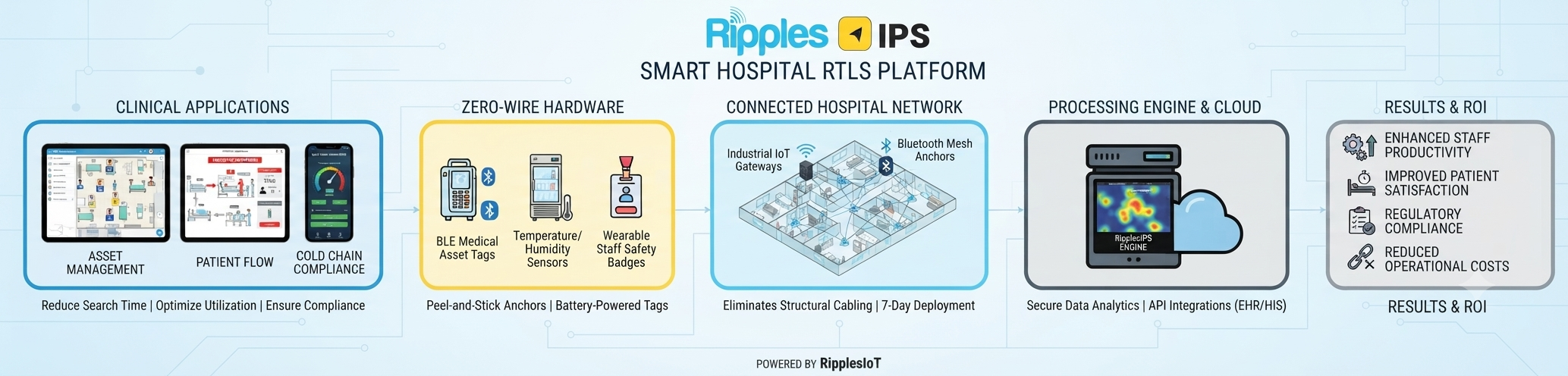
Patient Flow Optimisation with Real-Time Location Systems (RTLS)
Managing patient throughput and reducing wait times is critical for hospital efficiency. Ripples-FMS RTLS provides real-time visibility into patient movement across the ED, OR, and inpatient units:
Automated Intake & Wait Time Tracking: Monitor real-time patient progression through check-in, triage, and room assignments.
Bed Management & Turnover: Automatically trigger room cleaning alerts upon patient discharge to accelerate bed turnover.
Staff Safety & Duress Alerts: Equip healthcare workers with wearable panic badges for immediate location-based emergency alerts.
Real-Time Location Systems & Clinical Workflow Automation for Global Healthcare Networks
Ripples IoT deploys 0-wire Bluetooth RTLS solutions across hospitals and speciality clinics—tracking patients, staff, medical equipment, surgical kits, and pharmacy inventory in real time. The platform integrates seamlessly with existing hospital information systems, including the Vikas 2.0 hospital ERP, and deploys in under seven days with no cabling or infrastructure changes required.
Bluetooth RTLS Systems in Healthcare & Patient Tracking
Long patient waiting times in outpatient departments (OPD) and emergency departments (ED) are among the most visible operational challenges in modern healthcare. By deploying an advanced RTLS patient tracking system, front-office teams gain a live view of every patient’s location, time spent at each touchpoint, and queue status across all departments.
Continuous Wait Time Tracking: Monitor wait times continuously across every department and touchpoint, triggering instant alerts to the concerned clinical team the moment a threshold is breached.
Proven Deployments: Successfully deployed at leading nonprofit eye health facilities managing over 1,000 outpatients daily across multiple centres, significantly reducing peak-hour bottlenecks and enhancing the patient experience.
Indoor Positioning & Safety: Leveraging RipplesIPS sub-meter indoor positioning technology to ensure complete patient safety and accurate zone-based visibility. Explore our dedicated Healthcare RTLS Software & Vendor Guide to learn more about system architecture.
Why We Use Bluetooth AoA Instead of UWB
When evaluating indoor positioning for patient tracking, many hospitals assume Ultra-Wideband (UWB) is the only path to real precision. RipplesIPS instead runs on Bluetooth AoA (Angle of Arrival) — a positioning method that calculates a tag’s exact location from signal direction rather than signal strength, delivering sub-meter accuracy on standard Bluetooth infrastructure your facility already trusts.
Sub-Meter Accuracy, Zero Infrastructure Overhead: RipplesIPS Bluetooth AoA delivers 0.5– 1.0 meter positioning accuracy — precise enough to confirm exact patient location, not just a general zone. UWB can push accuracy tighter still, but requires dense anchor networks, tighter synchronisation, and heavier calibration per room. For hospital-wide patient flow and safety, that overhead buys precision most facilities don’t need.
Lower Cost, Longer Tag Battery Life: Bluetooth AoA tags draw significantly less power than UWB tags and cost a fraction to deploy at scale — a meaningful difference across a facility tracking hundreds of patients, staff, and assets simultaneously.
Automated Patient Flow Milestones: As a patient moves from triage to treatment to discharge, RipplesIPS logs each transition automatically — giving front-office and clinical teams real wait-time and bottleneck data without adding manual work for already-stretched staff.
Wandering and Elopement Prevention: For memory care, paediatric, and psychiatric units, AoA-level precision is enough to trigger an immediate, exact-location alert the moment a patient approaches a restricted exit — giving staff time to intervene before an elopement occurs.
The question isn’t which technology is more precise in a lab — it’s whether your facility needs centimeter-level accuracy badly enough to take on UWB’s infrastructure and cost burden. For patient flow and safety, most hospitals don’t, which is why RipplesIPS is built on Bluetooth AoA.
Hospital Asset and Medical Equipment Tracking
Hospitals invest millions in portable medical equipment—such as ECG machines, infusion pumps, ultrasound scanners, and ventilators—yet most facilities lack a reliable way to locate these assets when needed.
Real-Time Visibility: Utilise our dedicated hospital RTLS asset tracking module to monitor every tagged device across all floors in real time. For a broader view of asset tracking principles, see our Real-Time Location System Warehouse Inventory Tracking Management framework.
Automated Usage Logging: Generate hour-based utilisation reports and instant alerts when equipment is moved to unauthorised zones or subjected to abnormal handling.
Maintenance & Billing Support: 24/7 remote visibility supports equipment-based billing, helps plan preventive maintenance schedules, and provides tamper-evident movement history to strengthen insurance and warranty claims.
Operation Theatre (OT) Temperature & Humidity Monitoring
NABH, JCI, CBAHI, and international accreditation bodies require operation theatre temperatures to be maintained at 21°C ±3°C, with humidity tightly controlled at all times. Traditional manual thermometer checks leave dangerous compliance gaps.
24/7 Automated Logging: Wireless temperature and humidity sensors provide continuous, tamper-evident data logging.
Instant Escalation: Instant WhatsApp and email alerts notify the facilities team the moment environmental thresholds are breached.
Audit-Ready Reports: Store timestamped records that can be exported directly for accreditation submissions without requiring separate gateway infrastructure. This links directly with our specialised Condition Monitoring & Maintenance modules.
Hospital Pharmacy Workflow Automation
Pharmacy dispensing delays contribute heavily to patient wait times, particularly for refrigerated medications requiring manual searches through cold storage.
Pick-to-Light Guidance: Guides pharmacy staff directly to the correct shelf location for each prescription item, eliminating search time and dispensing errors.
Smart Counter Management: Staff call buttons at dispensing counters allow pharmacists to summon support or flag urgent prescriptions instantly.
Cold Chain Integrity: Reliable medical equipment tracking system architecture extends to temperature-controlled storage units, maintaining continuous logs alongside location data from storage to dispensing points.
Surgical Kit and Linen Tracking
Delays in OT preparation caused by missing surgical kits and sterile linen create daily operational friction.
Real-Time Location: Bluetooth tags attached to surgical kits, linen trolleys, and sterilization containers provide real-time location across sterile and non-sterile zones.
Streamlined Control: OT coordinators can locate any kit instantly from a dashboard without leaving the control desk, ensuring the right kit reaches the correct theatre on time while fulfilling rigorous hospital audit documentation requirements. For broader equipment and repair cycle tracking, review our Manufacturing Downtime Tracking Software integrations.
Global Regional Compliance & Localised Architecture
1. India & South Asia (NABH & JCI Compliance)
Supports NABH and JCI accreditation requirements across OT temperature logging, asset movement audit trails, and patient wait time tracking. All data is stored in tamper-evident logs exportable directly for review, with seamless integration into the Vikas 2.0 hospital ERP.
2. East Africa (Kenya, Tanzania, Uganda, Zambia)
Engineered to operate reliably on low-bandwidth and intermittent connectivity. Built-in offline data logging with automatic cloud synchronisation ensures zero data loss during power outages—making it ideal for private hospital networks (such as Aga Khan, AAR Healthcare, and Lifecare) as well as mission and peri-urban hospitals adhering to local Ministry of Health reporting standards.
3. Middle East (UAE & Saudi Arabia)
Designed to meet JCI and Saudi Central Board for Accreditation of Healthcare Institutions (CBAHI) mandates for continuous OT environment logging, sterile kit tracking, and patient safety records across expanding regional medical groups.
4. Canada (Cold-Climate Resiliency & PIPEDA/PHIPA Compliance)
Features severe thermal-tolerance hardware for cold-chain storage and transport down to -80°C freezers, coupled with strict adherence to regional healthcare privacy acts (PIPEDA and provincial PHIPA standards) via secure data residency options.
5. South Africa (Load-Shedding Resilience & Edge Sync)
Equipped with grid-resilient edge-caching and battery backups. Bluetooth anchors and gateways maintain uninterrupted 24/7 environmental logging during municipal load shedding, automatically syncing cached audit logs to the cloud once grid power returns.
6. European Union (GDPR & EN 12830 / GDP Standards)
Fully compliant with EU data protection laws (GDPR) and aligned with EN 12830 standards for temperature recording instruments, ensuring complete audit readiness for hospital pharmacies, blood banks, and clinical laboratories.
Frequently Asked Questions (FAQ)
1. How quickly can a hospital deploy the 0-wire RTLS system?
The platform installs in under 7 days with zero cabling or infrastructure changes. Battery-powered Bluetooth anchors and wearable tags integrate directly with your existing hospital information systems and benefit from clean Smart Warehouse Design topology concepts applied to clinical layouts.
2. Does the system integrate with hospital ERPs like Vikas 2.0?
Yes. Ripples IoT offers robust API integrations that connect seamlessly with Vikas 2.0 and other leading healthcare RTLS software platforms.
3. How does the system handle low-bandwidth or load-shedding environments?
For facilities across East Africa and South Africa, the platform features built-in offline data logging and local edge synchronisation, ensuring no compliance or patient tracking data is lost during power grid or internet outages.
4. Can the same sensor network monitor both pharma cold storage and OTs?
Yes. The same 0-wire Bluetooth mesh infrastructure supports environmental sensors for operation theatre climate logging, pharmacy refrigerators, and vaccine cold chains simultaneously.
5. How does RTLS improve patient flow in hospitals?
RTLS improves patient flow by providing real-time tracking of patient locations, care stages, and bed availability across hospital departments. By replacing manual status updates with automated BLE/UWB location tags, healthcare facilities reduce emergency room bottlenecks, minimise appointment wait times, accelerate bed turnover, and streamline discharge workflows.
6. Can healthcare RTLS integrate with existing EHR/EMR platforms?
Yes. Ripples-FMS connects via standard APIs and HL7/FHIR protocols with electronic health record (EHR) platforms like Epic, Cerner, and Allscripts to automatically sync patient status, room assignments, and care milestones in real time.
Beyond patient and asset tracking in clinical wards, systems scale to multi-site laboratory equipment tracking across distributed networks
Ready to evaluate RTLS in your healthcare facility? Explore our department-specific use cases—from Patient Flow RTLS to Healthcare RTLS Software & Vendor Guides—or contact our team to discuss custom network deployments and Employee Tracking, Productivity & Safety protocols